
Flashback: How Europe’s Battery Transition Is Taking Shape in the CEE
On 25 February 2026, Battery Industry Day in Riga brought together researchers, companies and public-sector stakeholders to discuss how Latvia can contribute to Europe’s battery value chain. For NaionX, the event reflected a clear market signal: battery innovation in the Baltics will be built on specialised technologies, testing capacity and commercially relevant performance.
NEWSEVENTS
NaionX
4/17/20261 min read
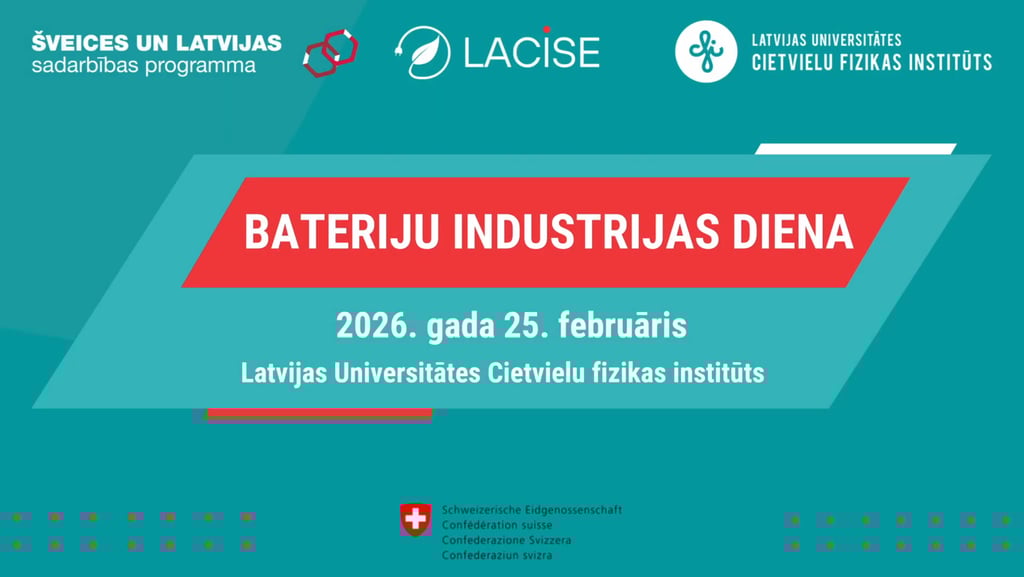
Battery Industry Day in Riga
Looking back, Battery Industry Day on 25 February 2026 at the Institute of Solid State Physics, University of Latvia, was more than a sector gathering. Held in Riga from 9:00 to 13:00, the event brought together researchers, companies and policymakers for a focused discussion on battery technologies, cooperation opportunities and the region’s role in the wider European battery market. The working languages were Latvian and English, which reflected the event’s practical ambition to connect local capability with a broader international industry context.
What the discussion put on the table
The agenda was grounded in real bottlenecks rather than broad ambition. Participants highlighted low-temperature battery performance, battery management systems, limited battery cell and system testing infrastructure, and the lack of established recycling and end-of-life pathways as core barriers slowing stronger sector development. The audience itself showed why the conversation mattered: universities, research institutes, energy and mobility actors, public-sector representatives and companies from electromobility, renewable energy, energy efficiency, defence and high-tech sectors were all part of it.
Europe’s framework, CEE & Baltic role
One of the strongest takeaways was strategic clarity. The Baltic region is unlikely to compete with large-scale global battery manufacturing on volume, but it can build a credible position through knowledge-based technologies, advanced materials, system integration and standardised testing. That matters in a European market where resilience, industrial capability and smarter value-chain positioning are becoming as important as scale itself.
Why it matters for NaionX
That logic fits NaionX directly. Our positioning is built around sodium-ion battery technology that is affordable, sustainable and scalable, with strong cold-weather relevance and a value proposition designed for European battery manufacturers and applications such as grid storage, electric mobility and industrial power. Internally, NaionX also frames its technology around lower production energy use, dual-electrode innovation and a market path shaped by practical deployment rather than distant scale narratives. In that sense, the event now reads as a useful flashback: not only to a sector conversation, but to the kind of battery industry framework in which NaionX can realistically create value.
